

New research suggests that Australia, Canada, and New Zealand are the most popular countries in the world for UK business expansion.
Business leaders have searched for start-up and expansion opportunities in these three countries on more than 42,000 occasions, making up 1 in 3 searches globally.
For British organisations aiming to scale internationally, experts at the cultural intelligence platform Country Navigator have developed the Global Expansion Business Report, analysing factors such as Search interest, annual GDP growth, unemployment rate, and headline corporate tax rate to identify the best EU countries for global businesses to operate from.
Most Popular Countries for Global Business Expansion:
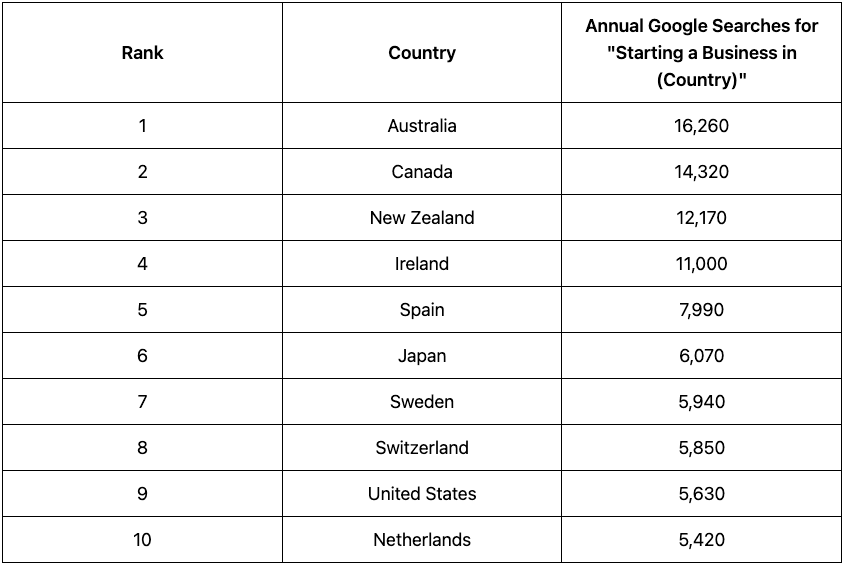
Australia, Canada, and New Zealand attract the highest levels of interest from businesses looking to expand internationally. Australia leads with more than 16,000 annual searches for starting a business, followed by Canada (14,320) and New Zealand (12,170) – all significantly above the global average of 3,594.
Several factors likely contribute to this demand. All three markets offer strong political stability, established legal frameworks, and English-speaking business environments, making them more familiar to UK-based companies.
This combination of familiarity and perceived ease of entry helps position these countries as natural first choices for international expansion.
Further insights into the state of Global Business Expansion:
- Ireland ranks as the best country for business expansion, scoring 7.67 out of 10, followed by Poland and Portugal in second and third place.
- Six of the top 10 countries are in Europe, highlighting the region’s strength as a destination for stable and scalable international growth.
- The United States ranks joint 17th, indicating that market size and global influence do not guarantee the strongest expansion conditions.
- Several of the world’s largest markets rank outside the top 20, including Germany (35th), France (21st), and Italy (25th).
- The most culturally aligned markets with the UK include the US, Finland, Canada, the Netherlands, and Denmark, all of which have lower average cultural distance scores and fewer barriers to communication and collaboration.
“Expanding into a new market is often approached as a structural challenge – securing the right tax setup, hiring locally, and navigating regulation. In practice, the biggest barriers tend to be operational.
“How decisions are made, how feedback is delivered, and how relationships are built can vary significantly between markets. In unfamiliar environments, these differences can slow progress, create misalignment within teams, and affect how quickly a business gains traction.
“This is particularly relevant when entering markets with strong fundamentals, but that feel less familiar. Without a clear understanding of local expectations, businesses can struggle to translate strategy into execution, even when the opportunity is clear.
“For leadership teams, this shifts the focus from market selection to team readiness. Preparing employees to operate effectively across different cultural contexts through approaches such as cultural intelligence training can help reduce friction, improve collaboration, and accelerate integration.
“In my experience, the difference between a successful expansion and a stalled one is not the market itself, but how well a business adapts to it.”